
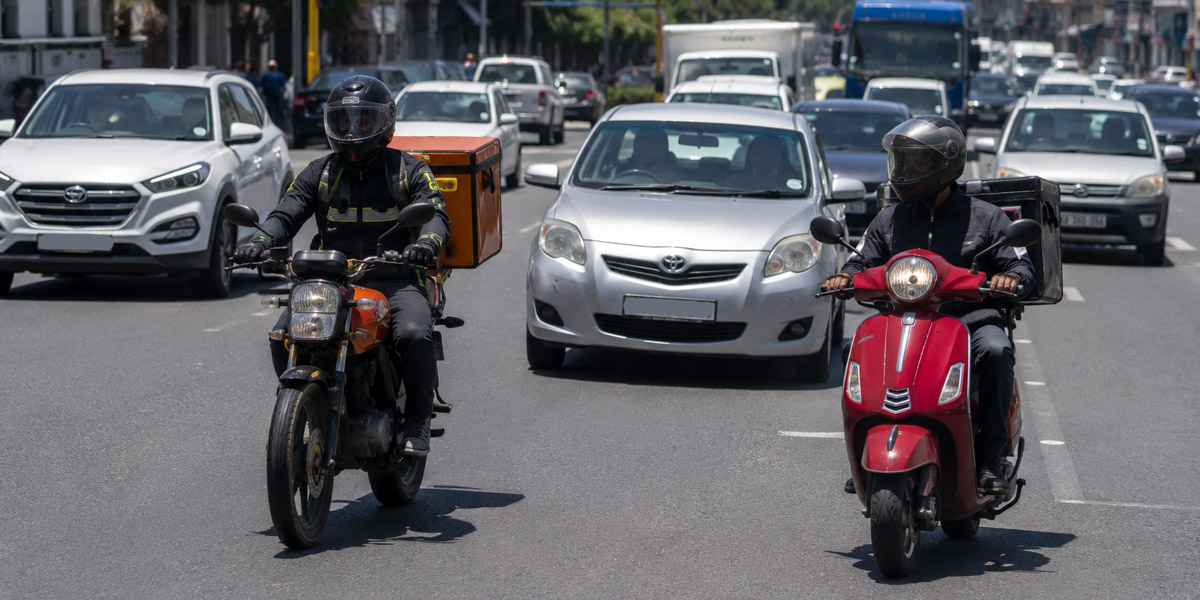
Twist-and-go is winning the argument in South African delivery work, and it is not hard to see why. Ask riders what they want and a growing number say the same thing: no clutch lever, no gear lever. Nothing to coordinate in stop-start traffic. Just twist and ride.
That preference is real, and it deserves to be taken seriously. But “riders find it easier” is not, on its own, a good enough reason to put a fleet — or yourself — on a scooter. There is a licensing catch that trips people up, a handling trade-off that most buyers never consider, and a maintenance cost that gets quietly ignored because the marketing only talks about what the scooter doesn’t have.
This article lays out the full picture: where scooters are genuinely the safer choice for delivery work, where they are not, and what to specify if you are buying.
The licensing catch nobody checks until it is too late
Start here, because this one has legal consequences and riders regularly get it wrong.
South Africa’s motorcycle licence codes are straightforward:
- Code A1 covers motorcycles and scooters up to 125cc, for ages 16 and 17.
- Code A covers anything above 125cc, from age 18.
If you already hold a Code A or A1 obtained on a manual bike, you may legally ride an automatic scooter of the matching capacity. No extra hoops.
Here is the part that catches people out. If you did your K53 test on a scooter, automatic transmission, you are licensed to ride automatic scooters only. You may not legally ride a geared motorcycle. That restriction is printed on the back of your licence card under the driver restrictions. Go and look at your card now if you are not sure.
For a rider, testing on a scooter is the fast, easy route in — but it locks the door behind you. If you later want to ride a geared bike, upgrading is not a formality: you will need to write the Code 1 motorcycle learner’s test again and pass the applicable K53 motorcycle test. That is time and money you may not have budgeted for, so decide deliberately rather than by default.
For an operator, it cuts both ways. Licensing new riders on automatics gets them working faster, and they can test on the same bike they will ride at work. But those riders are then licence-locked to automatics, which matters enormously in a mixed fleet. Audit rider licence codes at onboarding — including the automatic-only restriction — and make sure every licence legally matches the bike.
What removing the clutch changes
The safety case for an automatic is better than most people realise, and it has nothing to do with convenience.
Riding a geared motorcycle in dense traffic means managing clutch, throttle, gear selection, both brakes, road position and hazards all at once. For a new rider, that is a heavy cognitive load, and the bike ends up taking attention that should be going to the road. Remove the clutch and gears, and you free a meaningful chunk of that attention for traffic, hazards and road position — and on South African roads, attention is in high demand.
For anyone learning to ride, or coming into delivery work with limited experience, this is a genuine benefit: fewer stalls, fewer low-speed drops, less hesitation at junctions.
But an automatic changes the skill profile — it does not remove the need for skill. Three things get harder, not easier:
You lose engine braking. On a geared bike, closing the throttle while changing down slows you and helps manage speed into a hazard. A CVT scooter gives you very little of that. You rely on the brakes far more — and as you will see below, that matters a great deal on a small front wheel.
The throttle is instant. Twist means go, immediately and smoothly, with no clutch to feather. In tight, slow manoeuvring — exactly what delivery work is full of — that catches inexperienced riders out.
It can mask poor bike sympathy. Riders never develop throttle discipline through the gears, so bad habits stay invisible until something goes wrong.
The conclusion is not that scooter riders need less training. They need different training: progressive braking on small wheels, slow-speed throttle control combined with rear brake feathering, and hazard scanning that assumes no engine-braking cushion is coming to help.
Wheel size: the thing almost nobody asks about
MSI first raised this in 2017, and it remains the single most overlooked safety factor when buying a scooter. It is also where the money is best spent.
When most people picture a scooter, they picture the classic small-wheel look. But scooter wheels have been getting bigger, and there is a good reason for that.
Small-wheel scooters (10″ to 13″)
Twitchy handling. Small wheels create incredibly quick steering geometry. Manageable at low speed, but it makes the scooter unstable and nervous as speeds rise — and the more powerful the bike, the more often you will be in that range.
Vulnerability to road hazards. Like a skateboard hitting a pebble, small wheels transmit bumps and jolts severely and are deflected far more easily. Potholes, uneven surfaces, low shoulders and road cracks all carry a high crash risk. On South African roads, that is not a theoretical concern.
Traction loss. This is the one that hurts. On wet surfaces or loose gravel, smaller front wheels are far more likely to lose traction entirely under hard braking. Combine that with the lack of engine braking on an automatic, and you have a rider leaning harder on a front brake that has less margin to give.
Accelerated wear. A 10-inch tyre rotates significantly more times per kilometre than a 14-inch tyre, which means much faster tread wear — particularly on the rear drive wheel.
Large-wheel scooters (14″ to 16″)
Stability. Bikes on large-diameter wheels — the SYM Jet14 or the Hero Xoom 160 and 125, for example — settle down markedly at speed. Some designs bridge the gap a different way: the SYM Crox 125 runs a slightly smaller wheel but an exceptionally wide tyre profile, which recovers much of the stability.
Hazard mitigation. A larger wheel rolls over debris, cracks and potholes with far less disruption to the chassis.
Control. Larger wheels give a bigger contact patch and improved ground clearance for cornering, which inspires more rider confidence across varied road conditions.
That last point is worth emphasising: tyre width matters as much as diameter. The wider the tyre, the more rubber on the road, and better contact means more control on any surface, smooth or rough. Judge a bike on both numbers, not just the wheel size in the brochure.
The trade-off
Are there downsides to large wheels? Mainly storage. Fit larger wheels and the engine moves forward, the fuel tank usually drops into the floor platform and the battery gets pushed forward — so under-seat storage suffers. A top box solves that. And if your heart is set on the classic look, most large-wheel scooters have a more contemporary design.
There are millions of small-wheeled scooters out there and, with experience and training, they can be ridden safely. They are best suited to slower situations. But the honest position is this: if small-diameter wheels were genuinely better, why does nobody build a small-wheel superbike or dual-purpose bike? Rather pay a little more for a good quality large-wheel scooter than compromise on safety.
Small diameter is for coins, not for bikes.
Braking, weather and the rest of the ledger
A few genuine points in the scooter’s favour, which deserve fair credit:
- Weather protection. Body panels give real protection from wind and road splash in the rain. On a long shift in bad weather, that is not just comfort — a rider who is dry, warm and able to see is a rider still making good decisions in hour six.
- No clutch cable to wear, stretch or adjust.
- No chain and sprockets to lubricate, tension and replace.
- Less prone to excessive throttle use, because there is no gear changing to provoke it.
- More under-seat storage on conventional designs.
- A front disc brake is standard on most scooters — and many now offer combined braking (CBS) or ABS.
That last one deserves dwelling on. Budget geared commuter bikes are still frequently sold with drum brakes front and rear. CBS and ABS are a real asset for less experienced riders, who typically over-use one brake and under-use the other. Given the small-wheel front traction issue, this is where your money works hardest — prioritise a bike that offers them.
Whatever you ride, build conspicuity into the specification: high-visibility gear and good lighting, day and night.
The top box: a bigger deal than it looks
Almost every delivery bike carries a rear top box, and it is routinely treated as an accessory rather than as something that changes how the vehicle handles. It does — and on a scooter the effect is amplified, because a shorter wheelbase, smaller wheels and a higher, often further-rearward rack all change how the load reaches the chassis.
Three things drive top-box instability, and a loaded box is close to the worst case for all three:
Mass, height and rearward position. A loaded box sits high and behind the rider. Height raises the centre of gravity. Rearward mass lightens the front wheel and increases the bike’s tendency to yaw and weave. On a short-wheelbase scooter, the same box sits proportionally further behind the rear axle than it would on a longer motorcycle — so its effect is magnified.
Fore-aft placement — over versus behind the rear wheel. This is the single biggest lever whoever fits the box controls. A box mounted over or ahead of the rear axle keeps the load central, keeps weight on the front wheel and keeps yaw inertia low. A box cantilevered out behind the axle does the opposite: it works on a longer lever, lightens the front further and raises the polar moment. All that makes the steering flightier and a weave easier to trigger.
Mount it as far forward, and as low, as the rack allows.
Aerodynamics and width. A bluff, wide box is effectively a sail at the back. It presents side area behind the centre of gravity and sheds a turbulent wake — both of which can feed side-forces into a weave. It is worse in crosswinds and in the churned-up air behind trucks and buses, which is exactly the air you sit in when filtering on the left.
The width rule
Box width should not exceed the overall width of the handlebars.
Two reasons:
- Clearance. You judge gaps by your handlebars. A box wider than your bars will catch what your bars clear — and in dense traffic, that is how mirrors get taken off, and riders get pulled down.
- Crosswind. A narrower box presents less side area at the rear, reducing the aerodynamic forcing described above.
A box sized for a larger geared motorcycle may simply be too wide, and sit too far back, for a scooter. Size the box to the bike — not the bike’s mounting to a box you already own.

What goes inside it
The box’s own mass is only half the story. Pack heavy items low and forward, and secure them so nothing can slide in transit — a load that shifts mid-corner moves your centre of gravity at the worst possible moment. And stay within the rated limit of both the rack and the box.
The maintenance trade-off nobody mentions
“No chain, no sprocket, no clutch cable” is true, and it is a real saving in both money and daily rider maintenance. But it is not the whole story, and anyone budgeting for a fleet needs to hear the rest.
A twist-and-go does not eliminate driveline wear. It moves it inboard — to the CVT drive belt, the variator roller weights and the clutch shoes. In delivery duty, these are severe-use items. Constant launching, stopping, relaunching and heat cycling consume belt life far faster than gentle private commuting does. A snapped belt is an immediate roadside breakdown, not a gradual warning like a stretched chain.
This is scheduled maintenance, not a maintenance-free system. Plan and budget CVT service intervals from day one.
The same goes for parts. Whatever brand you buy, confirm local parts availability, dealer and workshop support and CVT consumable supply before you commit. A cheap bike with a thin parts pipeline is a bike that spends its life waiting for components.
So where do scooters fit?
Strong fit
Dense, low-speed, stop-start urban delivery. Twist-and-go convenience, weather protection and a gentler learning curve all count in the scooter's favour, and the reduced performance rarely bites.
Weaker fit
Routes with significant fast-road content, badly broken surfaces or gravel. Small wheels and lower performance become a liability, and the loss of engine braking is felt more.
Rider mix
If you are bringing in new or inexperienced riders, the reduced cognitive load is a meaningful safety benefit, provided the training is adapted to suit an automatic.
The short checklist if you are buying
- Specify large-diameter wheels, 14 inches and up, with adequate tyre width. Avoid 10–13-inch small-wheel bikes for all-day, mixed-surface work.
- Require a front disc, and prioritise CBS or ABS.
- Confirm South African parts supply, dealer support and CVT consumable availability.
- Build CVT service intervals — belt, rollers, clutch — into the maintenance plan from day one.
- Size the top box to the bike: within handlebar width, mounted low and as far forward as the rack allows.
- Check the licence code matches the bike, including the automatic-only restriction.
- Get training suited to an automatic: braking on small wheels, slow-speed throttle control, hazard scanning without engine braking.
Let me wrap this up
Scooters are a credible and, in the right conditions, a safer option for delivery work, but not automatically, and not all of them. The convenience of no clutch is real, and the reduced cognitive load is a genuine safety gain. Those benefits are undone quickly by a cheap small-wheel bike, a badly sized top box hanging off the back, or a maintenance plan that forgets the CVT exists.
Buy the wheels, not the badge. Fit the box properly. Train for the bike you are riding.
The Motorcycle Safety Institute of South Africa provides rider training and road safety advocacy for commuter and commercial riders.