

Understanding the invisible forces at play when you squeeze the levers could be the difference between a controlled stop and a life-altering collision.
Every rider loves the feeling of acceleration; the thrust that pushes you back into the seat as you roll on the throttle. But as the old saying goes, anyone can go fast; it takes skill to stop fast.
On South African roads, where variables change in a heartbeat, from sudden taxi stops to unexpected potholes, mastering emergency braking isn’t just a neat trick; it’s an essential survival skill.
Many riders think braking is just about squeezing levers. But beneath the surface, a complex battle of physics is taking place. The primary antagonist in this battle is Weight Transfer.
When you are riding at speed, your motorcycle and your body have incredible momentum. When you apply the brakes to stop the wheels, that momentum wants to keep moving forward. This causes the centre of gravity to shift violently toward the front wheel.
How you manage this weight transfer determines whether you stop safely or become a statistic. Let’s break down the three most common scenarios using physics as our guide.
The Visual Guide to Braking Physics
Below is a breakdown of the three critical braking scenarios. Refer to this diagram as we explore each concept.
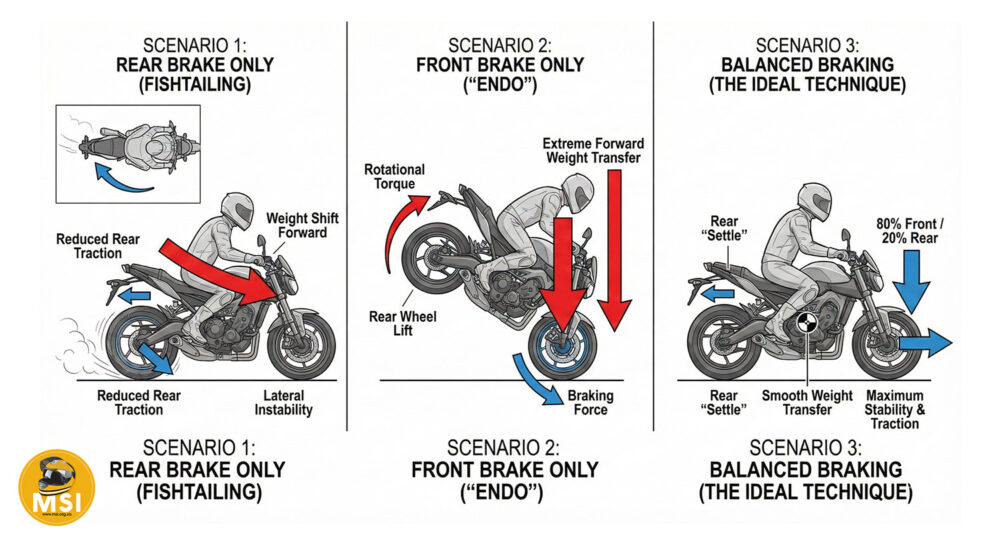
Scenario 1: The Rear Brake Trap (Fishtailing)
Refer to the left panel of the diagram.
Many new riders, or those taught decades ago, have an inherent fear of the front brake. They worry that using it will send them over the handlebars. In an emergency, their instinct is to slam on the rear brake pedal only, most commonly riders on cruisers.
The Physics:
As soon as you apply the brakes, weight transfers forward (indicated by the large red arrow in the diagram). This means the load on the rear tyre is drastically reduced. Traction requires downward pressure; without weight pushing the tyre into the asphalt, the rear wheel quickly locks up and begins to skid.
A skidding tyre has almost zero lateral (side-to-side) grip. Because the rear of the bike is now light and unstable, any slight camber in the road or shift in your body weight will cause the rear wheel to swing out from behind the motorcycle. This oscillation is known as “fishtailing,” an incredibly unstable situation that dramatically increases stopping distance and often ends in a “high-side” crash if the tyre suddenly regains grip sideways.
Scenario 2: The Front Brake Panic (The “Endo”)
Refer to the middle panel of the diagram.
On the other end of the spectrum is the panic grab. A rider sees a threat and, in a panic state of mind, abruptly grabs a fistful of the front brake lever.
The Physics:
Modern motorcycle front brakes are incredibly powerful. When applied abruptly without letting the suspension settle, the weight transfer to the front is violent. The front suspension compresses fully (dives), and the rear of the motorcycle becomes essentially weightless.
The forward momentum, acting on a high centre of gravity over a rapidly stopping front axle, creates massive rotational torque. If the front tyre has good traction on clean asphalt, the entire motorcycle will rotate around the front axle, lifting the rear wheel into the air, causing an “Endo.”
Note: On wet or gravel roads, a panic grab of the front brake often results in the front wheel locking up before the rear lifts, leading to an immediate front-end washout (a low-side crash).
Scenario 3: The Golden Technique (Balanced Braking)
Refer to the right panel of the diagram.
This is the goal. This is how professional riders and safety experts stop in the shortest, safest distance. It involves using physics to your advantage rather than fighting it.
The technique is often summarised as: Settle, then Squeeze.
The Physics of the 80/20 Split:
- The Settle (Rear Brake First): In an emergency, your first split-second action should be applying the rear brake gently. This does two critical things: it creates drag behind the centre of gravity, acting like a boat’s rudder to keep the bike straight, and it slightly compresses the rear suspension. This “settles” the chassis lower to the ground.
- The Squeeze (Front Brake Progressive): Immediately following the rear brake, you progressively squeeze the front brake lever. Because the rear is settled, the weight transfer forward is smoother and more controlled.
- The Balance: As weight inevitably shifts to the front, the front tyre gains massive traction (it is being pushed into the road), allowing it to do the bulk of the braking work. Simultaneously, the rear tyre loses traction.
To prevent lock-ups, a skilled rider increases pressure on the front lever while slightly decreasing pressure on the rear pedal as the stop progresses. On a sport or standard street bike on good pavement, this results in roughly 80% of the stopping force coming from the front, and 20% from the rear.
An Important Takeaway
Understanding the physics is step one. But physics doesn’t care how much you know when a car pulls out in front of you at 80km/h.
Muscle memory is everything. You cannot wait for an emergency to try balanced braking for the first time. You must practice the “settle and squeeze” technique in a controlled environment and through expert guidance until it becomes an automatic reflex.
At the Motorcycle Safety Institute of South Africa, we don’t just teach you to ride with more confidence; we teach you to survive. Our advanced rider course focuses heavily on higher speed evasive drills to ensure that when panic sets in, your training takes over.
Ride Safe. Brake Smart.


