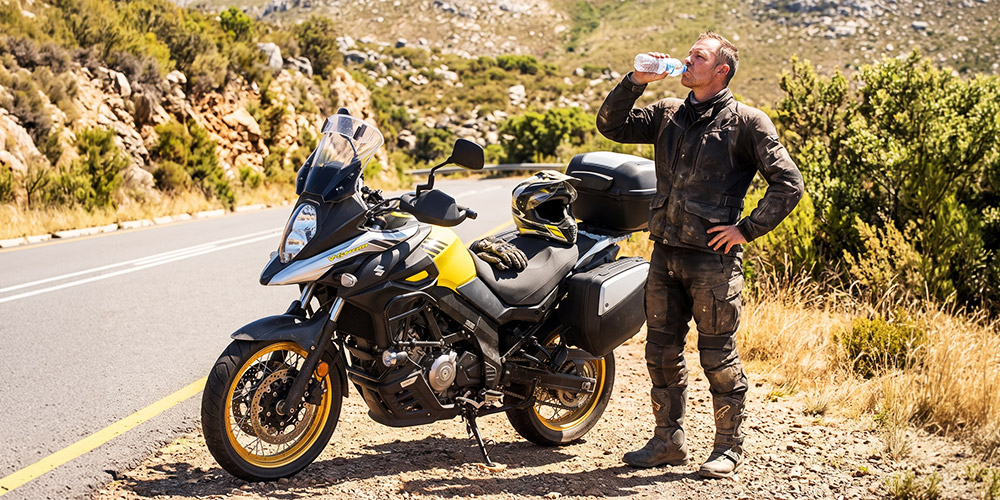
Losing as little as 2% of your body weight in fluid is enough to blunt your concentration and slow your reactions, and on a motorcycle, you can get there without ever feeling thirsty. Dehydration doesn’t announce itself like a puncture or a fuel light. It creeps in over a long ride or a hot delivery shift, quietly eroding the very things that keep you alive: attention, judgement and swift control.
In this article, I do a deep dive to explain how dehydration develops, how to recognise each stage, what the research says about its effect on road users, and the practical, evidence-based steps every rider and fleet operator can take to prevent it, or at the very least slow it down.
Why riders dehydrate faster than they realise
A rider sits in a moving column of air, often dressed in protective gear, exposed to the sun, the road surface and engine heat. That combination drains fluid quickly and hides the evidence.
- Sweat evaporates before you notice it. At riding speed, airflow dries your skin almost instantly. You don’t feel wet, so you assume you aren’t sweating, yet the fluid is still leaving your body.
- Dry air pulls water from your breath. Water is also lost from the lungs and skin through ordinary breathing, and the steady flow of dry air on a ride adds to this.
- Hot wind adds heat instead of removing it. Moving air cools you by convection only while it is cooler than your skin. Once air temperature passes roughly 30–35 °C, the wind starts heating you up, and your body sweats harder to compensate.
- Heat soak from gear, engine and tar. Jackets, helmets and boots trap heat. Engine and exhaust heat rise around your legs, and hot road surfaces radiate upward in stop-start traffic.
- Riders delay drinking. Many riders, like many drivers, drink less on purpose to avoid stops. Delivery riders working back-to-back drops often go hours without a drink.
- Diuretics and the night before. Alcohol the night before, and very large amounts of caffeine, increase urine output. Moderate coffee is generally not the problem; heavy caffeine intake and alcohol are.
The practical upshot: thirst is a late warning. It typically only switches on once you’ve already lost around 1% of body weight in fluid, and it doesn’t grow much stronger as things get worse, which makes it a poor gauge of how dehydrated you really are.
The stages and symptoms of dehydration
Dehydration is measured by fluid lost as a percentage of body weight. For a 75 kg rider, 1% is just 750 ml, about one large bottle of water. Medical sources draw the boundaries slightly differently, so treat the percentages below as a practical guide rather than hard lines.
| Stage | Fluid loss (% body weight) | Typical signs and symptoms | What it means on the bike | What to do |
|---|---|---|---|---|
| Early | Under 1% | Less urine, slightly darker colour, drier mouth. Usually goes unnoticed. | No obvious effect, but you are already behind. | Drink at your next safe stop. |
| Mild | 1–2% | Thirst, dry mouth, dark yellow urine, general tiredness, early headache. | Concentration and alertness start to fade, especially on long, monotonous stretches. | Stop, drink 500 ml or more, rest in the shade before riding on. |
| Moderate | 3–5% | Strong thirst, headache, fatigue, muscle weakness or cramps, dizziness when standing up, irritability, dry skin. | Slower reactions, poor judgement, cramps in hands and legs affecting clutch, brake and throttle control. You should not be riding. | Stop riding. Rehydrate with water plus electrolytes, cool down, and rest until symptoms clear. |
| Severe | Over 5–6% | Extreme thirst, rapid heartbeat and breathing, confusion, sunken eyes, little or no urine, fainting. | Riding is dangerous. Risk of collapse and heat stroke. | Medical emergency. Call for help. |
| Life-threatening | Around 10% and above | Disorientation, loss of consciousness, organ failure. | — | Emergency treatment, usually intravenous fluids. |
Two things in this table matter most to riders. First, the early and mild stages are easy to miss inside a helmet. Second, the moderate stage brings muscle cramps and dizziness, both of which directly affect your ability to control the motorcycle.
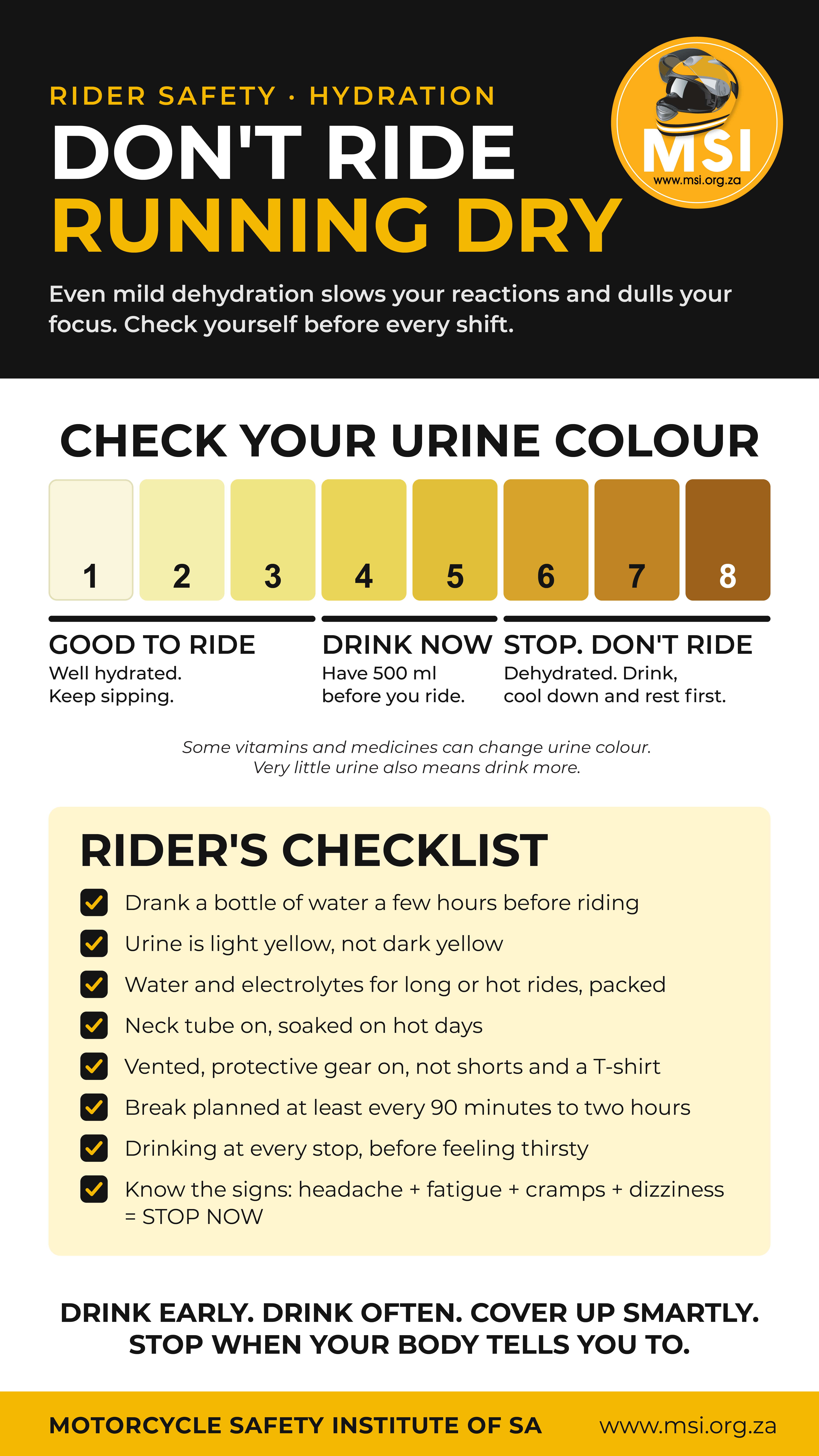
Check your urine. It’s the simplest field test available. Pale or light yellow is the target. Dark yellow or amber, or passing only small amounts, means you need to drink more before you ride on.
What dehydration does to your riding: the evidence
The clearest road-safety evidence comes from Loughborough University in the UK. In a 2015 study published in Physiology & Behavior, drivers completed a two-hour, monotonous simulated drive twice: once well hydrated (200 ml of fluid an hour) and once mildly dehydrated (25 ml an hour).
- When hydrated, they made 47 errors. When mildly dehydrated, they made 101 errors, more than double.
- The errors were lane drifting, late braking and touching or crossing the lane line or rumble strip.
- The researchers noted that this level of error is similar to what is seen in drivers at the UK drink-driving limit of 0.08% blood alcohol. South Africa’s limit is lower, at 0.05%.
- The dehydration level was described as mild, the kind anyone might reach on a busy working day with limited access to fluid.
Other findings point the same way:
- The American College of Sports Medicine advises keeping fluid loss below 2% of body weight, the point at which physical and mental performance is compromised.
- A University of Queensland researcher studying Australian superbike racers found riders are at greater dehydration risk than car racers, and uses the same under-2% target, with urine that stays a pale-yellow colour.
- In a separate simulator study, drivers at 1% and 3% fluid loss reported feeling less alert, less able to concentrate, more tired and light-headed, even though their short laps were not yet slower. Feeling foggy is often the first sign, before performance visibly drops.
A fair caveat: these are small studies, most in car simulators, and no one has yet measured dehydration’s effect on real motorcycle crash rates. But a rider has no cage, no seatbelt and far less margin for a late braking error or a drift across the lane line. The direction of the evidence is clear enough to act on.
Prevention: before, during and after the ride
The goal is simple: start the ride fully hydrated, replace fluid steadily while you ride, and make up any shortfall afterwards. The figures below come from the American College of Sports Medicine’s fluid replacement guidance, adapted for riders.
Before you ride
- Pre-load. Drink about 5–7 ml per kg of body weight roughly four hours before a long ride or shift. For a 75 kg rider that’s 375–525 ml, about one bottle.
- Top up if needed. If your urine is still dark, or you haven’t passed any, drink another 3–5 ml per kg about two hours before you leave.
- Eat properly. A normal meal with some salt helps your body hold on to the fluid you drink. Riding on an empty stomach makes everything worse.
- Watch the night before. Alcohol increases fluid loss and impairs you in its own right. Avoid it before an early ride.
While you ride
- Drink before you’re thirsty. Plan to drink at every fuel stop, every break and, for delivery riders, at every drop-off or pickup.
- Know the rough numbers. General guidance for activity is about 400–800 ml an hour. On hot days, 500 ml an hour is a bare minimum and 1–1.2 litres may be needed.
- Stop regularly. Plan a break at least every 90 minutes to two hours. Get off the bike, get into shade, take your helmet off, drink and stretch.
- Add electrolytes on long or hot rides. On rides longer than about 90 minutes, or if you sweat heavily, use an electrolyte drink or rehydration sachet alongside water, and eat something salty. Sodium helps your body retain fluid and replaces what you sweat out.
- Only drink in a safe position. Never take a hand off the bars to drink while moving; seriously! Drink when stopped or use a hydration or camel pack whose mouthpiece you can reach hands-free, and only where traffic conditions allow.
- Keep it cool. Cool water is more pleasant, so you’ll drink more of it. An insulated bottle or hydration pack helps.
After you ride
- Replace what you lost. For every kilogram of body weight lost during the ride, drink about 1.25–1.5 litres over the next few hours. Remember, you don’t sweat sugary drinks or coffee, and if you drink a soft drink or cup, be sure the drink an equal amount of water.
- Include salt. A meal with normal salt, or an electrolyte drink, helps you retain the fluid rather than passing it straight through.
- Check your urine before your next ride. Light yellow means you’re ready.
Gear and simple devices that slow fluid loss
Drinking replaces fluid. Good gear reduces how much you lose in the first place. The less heat your body has to shed, the less you sweat.
The neck tube (Buff)
A technical neck tube is one of the cheapest, most effective tools a rider can carry, provided you understand what it does and doesn’t do.
- It shades the neck and ears. The neck is a large, exposed area that takes direct sun. Covering it reduces the heat your body absorbs, so you sweat less. Look for a stated UPF rating; UPF 50+ blocks around 98% of UV.
- It turns sweat into cooling. A moisture-wicking microfibre tube spreads sweat over a larger surface, where airflow can evaporate it and carry heat away, rather than letting it run into your eyes or soak the helmet liner.
- Soak it for evaporative cooling. On hot days, wet the tube with cool water at each stop. Evaporation from the fabric cools the blood vessels close to the skin of your neck. Re-soak at every stop, because hot, dry wind dries it quickly.
- It closes the gap at the collar. In cold or windy conditions, the same tube stops the cold air draft between helmet and jacket.
- It’s a visor cloth too, for use only when you’re stopped in a safe place.
Two honest limitations. Evaporative cooling works best in dry heat; in humid conditions, like a summer’s day on the KwaZulu-Natal coast, the effect is noticeably weaker. And a neck tube slows fluid loss; it doesn’t replace drinking.
Ventilation and riding gear
- Never strip off protective gear to cool down. Shorts and a T-shirt trade a fluid problem for a skin-and-bone problem. Choose summer-weight textile or mesh gear with vents instead.
- Open vents up to about 30–35 °C. Below that, airflow cools you. Above it, the wind is hotter than your skin and adds heat, so close vents partly and keep skin covered with breathable, wicking layers.
- Wear a wicking base layer, not cotton. It moves sweat away from the skin so it can evaporate.
- Light colours absorb less sun than black.
- Use your helmet’s vents, and keep the liner clean. A sweat-soaked liner holds heat.
Other useful devices
- Hydration pack or bottle. Makes regular sipping easy. Insulated tubes keep the water cooler.
- Evaporative cooling vest. Soaked in water and worn under a vented or mesh jacket, it can provide relief for an hour or more in dry heat. It needs airflow to work, so it’s less effective under an airbag vest or a closed jacket.
- Insulated bottle on the bike or in a top box for delivery riders.
- Electrolyte sachets carried in a pocket or kit bag.
Plan around the heat
Where you can, ride in the cooler parts of the day, avoid the midday peak, and plan routes with shaded stopping points.
Don’t overdo it: too much plain water
More is not always better. Drinking large volumes of plain water quickly, especially during long, sweaty efforts, can dilute the sodium in your blood. This is called hyponatraemia, and in severe cases it can cause seizures and be fatal.
Its early symptoms – nausea, headache, confusion and fatigue – look a lot like dehydration, which is what makes it dangerous: the instinct is to drink even more water.
The fix is straightforward:
- Drink steadily rather than gulping litres at a stop.
- Aim to replace what you lose, not more. If you weigh more after a ride than before, you drank too much.
- On long or hot rides, include electrolytes and salty (not greasy) food alongside water.
- Riders on diuretic medication, or with heart or kidney conditions, should ask their doctor for personal fluid guidance.
When it goes further: heat exhaustion and heat stroke
Dehydration and heat work together. Left unchecked, they lead to heat exhaustion, and heat exhaustion can progress to heat stroke, which is a medical emergency.
| Heat exhaustion | Heat stroke | |
|---|---|---|
| Skin | Heavy sweating; pale, cool, clammy skin | Hot, red skin; may be dry or still sweating |
| Pulse | Fast and weak | Fast and strong |
| Mind | Tired, irritable, dizzy, may faint | Confused, slurred speech, altered behaviour, may lose consciousness or have seizures |
| Other signs | Headache, nausea or vomiting, muscle cramps, thirst | Very high body temperature (about 40 °C or more), throbbing headache |
| Response | First aid: stop riding | Emergency: call for help immediately |
First aid for heat exhaustion
- Stop riding. Park safely and get the rider into shade or a breezy space.
- Remove the helmet and open or remove the jacket and boots.
- Lay them down and cool them with wet cloths on the neck, armpits and groin. A soaked neck tube is ideal.
- Give small sips of cool water or an electrolyte drink.
- If symptoms don’t improve within an hour, get worse, or vomiting continues, get medical help. Do not let them ride on.
First aid for heat stroke
- Call for emergency help: 082 911 (Netcare 911), 084 124 (ER24) or your local EMS.
- Move the person to a cool, shaded place and remove outer clothing and gear.
- Cool them as fast as possible: cold water, wet cloths, fanning, or ice packs on the neck, armpits and groin.
- Do not force a confused or drowsy person to drink.
- Stay with them until help arrives.
For fleet operators
Delivery riders face the highest exposure: long shifts, short stops and pressure to keep moving. The Loughborough researchers themselves concluded that driver education should include hydration. Practical fleet measures:
- Make clean/safe water and electrolyte sachets available at hubs and stores, and build drinking into the rider’s routine at every pickup.
- Issue two neck tubes per rider so one is always clean, and show riders how to use the water-soak cooling technique.
- Schedule real breaks on hot days and, where possible, avoid peak-heat dispatching.
- Train supervisors to recognise heat exhaustion and to stand a rider down without penalty.
- Include urine-colour charts in rider rest areas or mobile communication network.
The rider’s checklist
Download our free checklist, keep it on your phone and share it with friends.
References
- Watson P, Whale A, Mears SA, Reyner LA, Maughan RJ (2015). Mild hypohydration increases the frequency of driver errors during a prolonged, monotonous driving task. Physiology & Behavior 147: 313–318.
- Loughborough University (2015). Dehydrated drivers make the same number of mistakes as drink drivers.
- Fleet News (2015). Driving while dehydrated the same as drink driving.
- Sawka MN et al. (2007). American College of Sports Medicine position stand: Exercise and fluid replacement. Med Sci Sports Exerc 39(2): 377–390.
- California State University Northridge. Hydration: fluid replacement (summary of ACSM guidance).
- Mollica J, Desbrow B, Irwin C (2019). No impact of heat stress and dehydration on short duration simulated motor-racing performance. Int J Exerc Sci 12(6): 960–970.
- WebBikeWorld. Motorcycle rider hydration study (University of Queensland research).
- CIEAH, Universidad de Las Palmas. Signs and symptoms of imminent dehydration.
- Cecelia Health. Dehydration facts.
- WebMD (2025). Dehydration: signs, symptoms and effects.
- Mayo Clinic. Hyponatremia.
- WRIC / CDC guidance. Heat exhaustion and heat stroke symptoms and first aid.
- ABC30 / CDC guidance. Heat stroke vs heat exhaustion.
- DrivingTests.co.nz. Riding a motorbike in hot weather.
- Arrive Alive. Preventing dehydration on motorcycle rides.