Why psychology is just as important as clutch control in motorcycle training.
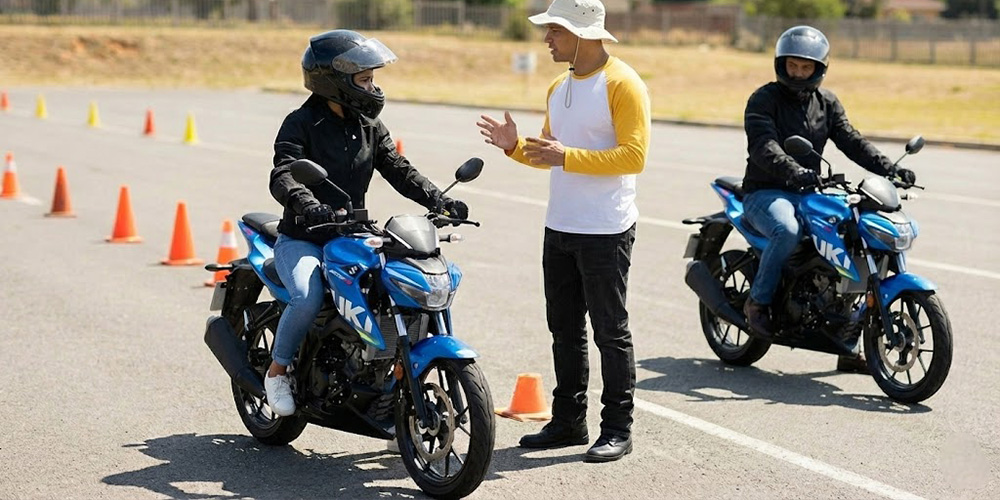
It is 10:00 AM on a Saturday. The sun is already baking, and you have two students on the range, riding identical motorcycles, attempting the same basic turning exercise. You have given them the same demonstration and the same verbal instruction.
Student A is smooth, relaxed, and looking through the turn. Student B is rigid, sweaty, stalling constantly, and staring at the front mudguard.
As instructors, our natural instinct is to fix the mechanical error. We shout, “Look up!” or “Ease the clutch!” But more often, the problem isn’t the hands or the feet, it’s the head. An instructor is part mechanic, part rider, and part psychologist. To truly master the range and improve your training standards, you need to learn to read the student’s mind before you can correct their riding.
Here are the three most common “student types” we see in South African riding schools, and how to handle them.
1. The “Frozen” Student (The Fear Factor)
We have all seen this student. They have the “death grip” on the handlebars, their shoulders are up by their ears, and their breathing is shallow. When you give an instruction, they look at you, but the words don’t seem to sink in.
The Diagnosis:
This student isn’t being difficult or “slow.” Their survival instinct has kicked in. Their brain is in “fight or flight” mode, screaming that this machine is dangerous. When cortisol spikes like this, cognitive function drops. They are suffering from sensory overload; they literally cannot process your verbal commands because their brain is too busy trying to survive.
The Fix:
- The Hard Reset: Do not shout louder. Raising your voice only adds to the stress. Signal them to stop the bike and put the side stand down. Ask them to take off their helmet for a moment and take five deep breaths. Break the tension.
- Regress the Exercise: If they are struggling with a turn, they are not ready for it. Move them back to a straight-line friction zone walk. Give them a “small win” to rebuild confidence before trying the turn again.
- Watch Your Tone: Use a low, calm, reassuring pitch. Your calmness will regulate their anxiety.
2. The “I Grew Up on a Farm” Student (The Ego Factor)
This student usually arrives with their own gear (sometimes inappropriate) and an attitude that says, “I just need the piece of paper.” They may have ridden off-road for years or “borrowed” a friend’s bike. They tend to cover the front brake with four fingers, ignore blind spot checks, and get impatient with the basics.
The Diagnosis:
This student is trying to validate their identity as a “rider.” When you correct their posture or braking technique, they don’t hear helpful advice; they feel an attack on their skill level. They often struggle with the K53 observations because they feel they “can see fine” without turning their head.
The Fix:
- The Precision Challenge: Don’t challenge them on speed; they are comfortable with speed. Challenge them on precision. The “Slow Race” is the great humbler. If they cannot ride at a walking pace without wobbling or putting a foot down, they don’t have true control.
- Reframe the Narrative: Explain that riding on dirt is about looseness, but riding on the road is about predictability. Frame the head checks not just as “moving it,” but as urban survival tactics against South African taxi drivers and distracted motorists.
- “Unlearning” is Harder: Acknowledge their experience (“I can see you’re comfortable with the throttle…”) but emphasise that bad habits are harder to break than learning new ones.
3. The “Brain Overload” Student (Analysis Paralysis)
This student asks about the physics of counter-steering before they have even mastered pulling away. They over-analyse every movement. If they stall, they want a 10-minute explanation of why, rather than just restarting the bike.
The Diagnosis:
These are intellectual learners. They are trying to solve a physical problem (riding) using logic and theory. They get frustrated by the lack of immediate perfection because, in their minds, they understand the theory, so the body should follow.
The Fix:
- Less Talk, More Ride: Politely limit their questions. Use the phrase: “Don’t think it, feel it.”
- One Focus Point: Do not give them a list of three corrections. Give them one single focus point per run. For example: “On this lap, I want you to ignore the clutch and just focus on pointing your chin where you want to go.” This quiets the noise in their head.
The Feedback Sandwich
Regardless of the student type, how you deliver the correction matters. We want to build safer riders, not crush their spirits. Use the “Feedback Sandwich” technique:
- The Top Bun (Validation): Start with something they did right. “Good job on keeping the throttle steady…”
- The Meat (The Correction): Insert the specific fix. “…but you need to keep your head up and look through the turn, rather than at the cones…”
- The Bottom Bun (The Outcome): End with why this helps. “…which will make the bike feel much lighter and easier to turn. Let’s try again.”
Remember
There is no “one size fits all” in motorcycle training. The curriculum might be standard, but the humans are not.
When we stop trying to force every student into the same box and start adapting our teaching style to their mindset, we reduce frustration on a range. More importantly, we produce students who aren’t just mechanically proficient, but mentally prepared for the reality of the road.