Your students tend to believe what they see, rather than what they hear.
Here is why your demonstration ride needs to be a flawless performance every single time.
Imagine the scene: It’s a scorching afternoon on the range. You are explaining the emergency stop. You tell the students clearly, “Apply the brakes progressively, squeeze, don’t grab.” You jump on the bike to demonstrate. But because you’ve done this a thousand times, you’re a bit casual. You ride fast, you brake hard, the front suspension drops sharply, and you stop on a dime.
The students are impressed. They Wow. Then they get on their bikes and immediately grab a handful of front brake, locking the wheel.
Why? Because they didn’t hear the word “squeeze.” They saw a sudden, aggressive stop.
In motorcycle training, the eyes are the primary learning channel. Students in a high-stress environment will subconsciously mimic your physical body language far faster than they will process your verbal instructions. This is why the demonstration ride is not just a quick “show and tell”, it is a calculated performance.
Here is how to master the art of the demo.
1. The Golden Rule: Consistency Kills Confusion
The phrase “Do as I say, not as I do” is the most dangerous sentence in rider training.
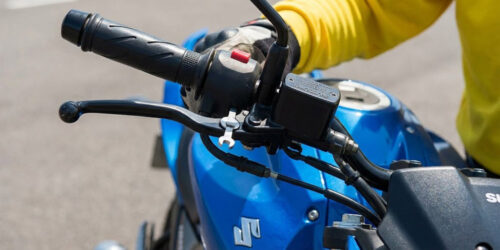
If you teach using four fingers on the front brake, you must never be caught lazily using two fingers while riding a bike around the range. If you tell students to keep their heads up, you cannot look down at your tank while riding to the start line.
Your students are looking for shortcuts. If they see the instructor taking a shortcut, even for a second, they will assume it is acceptable for them, too. You must treat every moment you are seated on a motorcycle as if you are undergoing a strict grading test. You are the standard they aspire to; make sure it’s a perfect one.
2. Stagecraft: Setting the Scene
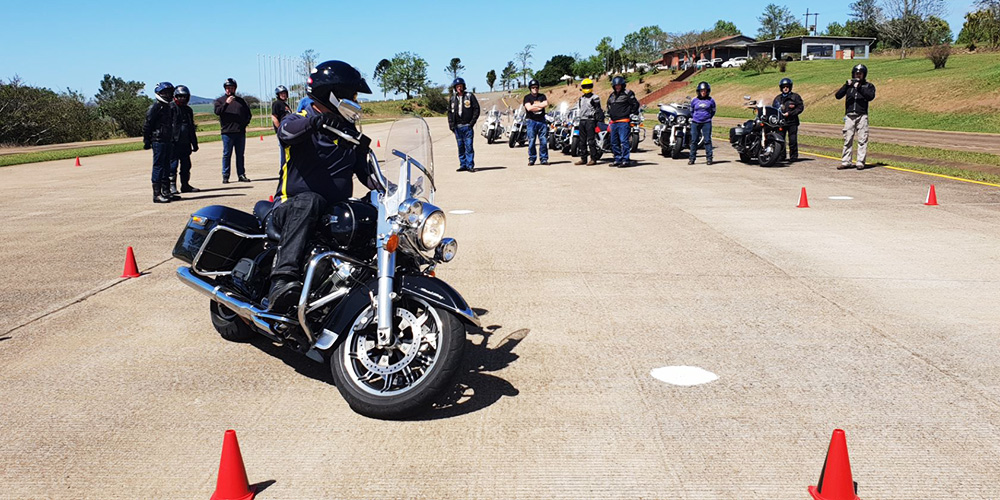
A perfect demonstration is useless if half the class can’t see the critical moment. Before you even start the engine, you need to think like a theatre director.
- The Sun: In South Africa, the sun can be blinding. Never position your class facing into the sun; they will squint, lose focus, and miss the details.
- The Angle: If you are demonstrating rear brake control during a slow-speed U-turn, don’t park the students on the left side of the exercise. They need to be on the right, where they can actually see your foot pressing the lever.
- Safety: Ensure the students are close enough to see the mechanics of your riding, but safely out of the potential “crash zone” if something goes wrong.
3. The “Silent Movie” Technique
When we ride naturally, our movements are subtle. A slight shift in weight or a gentle pressure on the bar is enough to turn the bike. However, these subtle movements are invisible to a novice watching from 20 meters away.
For a demo, you need to amplify your riding. You must ride almost “cartoonishly” to make the technique visible.
- The Head Check: Don’t just glance with your eyes. Turn your face all the way to your shoulder so they can clearly see the helmet rotate.
- Body Language: If you are demonstrating acceleration, lean forward slightly more than necessary. If you are braking, brace your body visibly.
Make the invisible physics visible through your posture.
4. Slow Down to Speed Up Learning
There is a temptation to ride at “instructor speed” to show competence. Resist it. A high-speed demo impresses nobody and intimidates everyone.
Perform the demonstration at the slowest possible speed that still allows the physics of the exercise to work. This gives the students’ brains time to process what is happening. If you rush the demo, they miss the nuance.
5. The Narrative: Tell Them What to See
If you just say, “Watch me do this,” their eyes will wander. One student will look at your helmet, another at the wheels, and another at the cones.
Pre-Demo Prime:
Before you pull away, tell them exactly where to focus.
- “For this run, I want you to ignore the cones. Just watch my left hand and how slowly I release the clutch.”
Post-Demo Recap:
Immediately after the run, ask them: “What did you see my left hand do?” This forces them to engage analytically with the demonstration rather than just watching it like a movie.
Go for Excellence
The “Art of the Demo” requires physical discipline and mental focus. It is tiring to ride perfectly, with exaggerated movements, hour after hour. But the payoff is huge.
A clear, flawless, and well-staged demonstration cuts down your verbal explanation time by half and gets your students riding correctly much sooner.
Remember: If a picture is worth a thousand words, a perfect demo is worth a thousand corrections.