
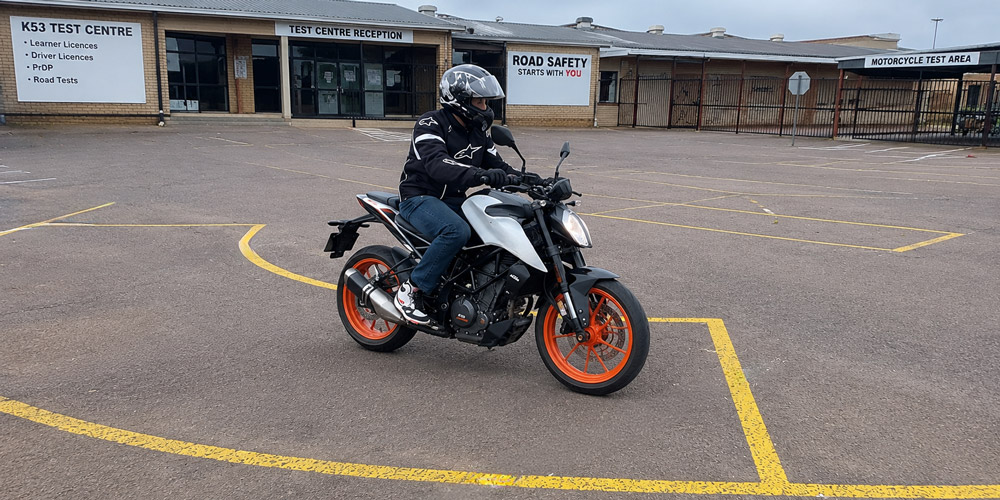
Why the K53 motorcycle test puts riders on the road before it ever checks whether they can survive it
In South Africa, a person can prove they can ride a motorcycle inside a marked-out box of 15 by 38 metres, at no more than 25 km/h, using nothing beyond second gear — and then walk away with a full licence to ride any motorcycle, through all the gears, at every legal speed (yeah right), on any road in the country.
Read that again. The test tops out at 25 km/h in a car park. The licence it hands over is valid at 120 km/h on the N3, in traffic, in the rain, at night, on a machine that can out-accelerate most sports cars and the real skill of most riders.
Someone built a licensing system that tests one thing and permits another thing entirely. And it is riders who pay for that gap — often with their lives.
What the test measures
The K53 motorcycle test is conducted on a closed range. The rider is asked to move a motorcycle around a small, controlled yard: slow manoeuvres, a few turns and stops, observations and turn signals — all at low speed and never out of second gear.
That is not nothing. Low-speed balance and control matter. But let’s be honest about what has, and has not, been assessed by the time that licence is issued.
The test never sees the rider at road speed, where it matters most. It never sees them brake hard at so-called legal speeds. It never sees them take a corner at speed, judge a gap in moving traffic, read the intentions of a minibus taxi, position themselves correctly in a lane, or make a single real decision in the company of other road users at an intersection.
In other words, the test checks whether you can shuffle a bike around on an empty yard. It does not check whether you can ride on the road and navigate real traffic. Those are not the same skill, and pretending they are is where the danger begins.
Everyone else is tested on the road — except us
Here is the part that should make every rider angry.
Every other class of road user in this country is tested on the road. Learner car drivers do a yard test and then a road test. Minibus taxi drivers, truck drivers, bus drivers — all of them are put into real traffic with an examiner watching, precisely because a yard cannot tell you whether someone is fit to share the road with the public.
The state has already decided, for every other vehicle, that a closed range is not enough. On-road assessment is the standard. It is the norm. It is treated as the bare minimum of responsible licensing.
And then it exempts the most vulnerable road users, the one road user who is more exposed than any of them.
A motorcyclist has no cage, no crumple zone, no airbags. When it goes wrong on a bike, the rider absorbs it with their own body. The most vulnerable road user on our roads is the only one we do not bother to test on those roads. That is not an oversight — it is discrimination built into the system, and it is exactly the wrong way round. The people most at risk are assessed the least.
Why this gets riders killed
Staying alive on a motorcycle has very little to do with idling around a yard in first gear. It has everything to do with roadcraft: observation, anticipation, road positioning, being seen, cornering, and emergency braking from real speed.
- Can the rider read the road far enough ahead to see a hazard before it becomes an emergency?
- Do they know where to sit in the lane — keeping left, buying themselves space, staying visible?
- Can they brake hard and in control from open-road speed without locking up and going down?
- Can they hold their line and their nerve when a taxi cuts across them or a car changes lane without warning?
None of that is on the test. Not one item. We license riders without ever confirming they possess any of the skills that keeps them alive. Then we send them out onto some of the most dangerous roads in the world and act surprised at the outcome.
The test not only fails to prepare riders. It hands them — and everyone around them — a false signal that they are ready when they are not.
A licence that means far too little
When a licence is issued, it is supposed to mean something. Families trust it. Insurers price on it, what a joke. The riders themselves believe it. The stamp says: this person has been assessed and found competent to ride on the road.
Except, in the case of the K53 motorcycle test, it says no such thing. It says the person could operate a motorcycle in a yard at 25 km/h. The rest — the actual riding, on the actual road — they will now attempt for the first time, alone, unassessed, with a full licence already in their pocket.
And here is the most dangerous part of all. The rider does not know what they were never tested on. They passed. They are licensed. So, they ride out believing they are ready — “I’m licensed, I can ride” — carrying a confidence the test did nothing to earn.
False confidence on a motorcycle is not a small thing. It is the difference between easing off before a corner and arriving at it way too fast. It is the difference between hanging back from a taxi and sitting square in its blind spot. The K53 method does not simply leave a rider unprepared — it actively convinces them that they are prepared. It tells a person who has never once ridden in traffic under assessment that they have made the grade. That false sense of competence, handed over with the licence, is exactly the mindset that gets a new rider hurt or killed in his or her first week of riding on the road.
The K53 motorcycle licence is almost meaningless as a measure of road readiness — worse, it’s been made a source of misplaced confidence — and it’s been done quietly, for decades, while riders keep dying.
The fix is not radical. It is overdue.
MSI’s position is simple: motorcyclists must be tested on the road, like every other road user.
Keep the closed-range test as a foundation — low-speed control is a fair first hurdle. But it cannot be the whole test. It must be followed by a supervised on-road assessment in real traffic, where an examiner can see whether the rider can really do the things that riding a motorcycle on a public road demands.
This is not about making licensing harder for the sake of it. It is about making the licence honest. It is about applying to motorcyclists the same standard we already apply to every car, taxi and truck driver in the country. Nothing more, and certainly nothing less.
Until that’s done, riders are merely licensed, a meaningless permission slip handed to the most vulnerable people on the road, based on a test that never once put them where the danger really is.
A solution worth considering
None of this requires tearing down the system we already have. There is a model that could sit neatly alongside K53 and close the very gap described above: CBT before Learners.
CBT (Compulsory Basic Training) is a mandatory course that a rider must complete before they are allowed onto public roads as a learner. It is built around five stages that move the rider from theory, to the motorcycle’s controls, to riding in a yard, to a road-safety briefing, and finally out onto the public road under direct supervision — with the instructor following and guiding the rider by radio for a minimum period of real on-road riding. Importantly, it is not run by government examiners, and it is not a pass-or-fail test in the traditional sense. It is delivered by approved riding schools, and the rider only moves forward once the instructor is satisfied at each stage. The whole course runs across a single day.
That final stage — real, supervised riding in real traffic — is the piece South Africa is missing. CBT gets a novice onto the road, under the eye of a trained instructor, before they are ever turned loose alone, and it does so without asking a licensing examiner to ride or drive behind every candidate on a public road. That is the practical objection to on-road testing answered in full. Some riding schools already have the right instructors, equipment and structure to do this; a testing authority does not, and building that capacity into the examiner corps would be slow, costly and difficult. A CBT-style course is quicker, cheaper and easier to roll out than bolting an examiner-led road test onto the current process.
Here is how it could work locally, without disrupting anything already in place. The Department of Transport would endorse and approve a selection of riding schools to deliver a standardised Basic Rider Course — or the MSI Urban Rider Course — as a pre-qualification. A candidate would complete that course at an approved riding school before being permitted to apply for a motorcycle learner’s licence. The K53 process carries on exactly as it is; the CBT-style course becomes the entry gate in front of it, so that every rider has had proper foundational instruction before they even begin the licensing journey.
It raises the floor without moving the goalposts. It hands the on-road component to the people best placed to deliver it — accredited riding schools — rather than to an examiner corps that would have to be built from scratch. And it is a model that would work not only in South Africa, but across every country in Africa facing the same problem.
The current system does not have to be dismantled. It has to be improved. CBT shows one realistic, affordable way to do exactly that.


