Measured, Not Guessed
A delivery motorcycle is a working tool. It runs eight to twelve hours a day, fully loaded, in all weather and traffic conditions. When a fleet buys the wrong bike, or a good bike arrives badly set up, the cost shows up in crashes, breakdowns, rider fatigue and lost deliveries.
Yet many purchase decisions still rest on a spec sheet, a short test ride and a gut feel. At the Motorcycle Safety Institute of South Africa (MSI), we believe fleet owners deserve better. Our motorcycle evaluations now combine a structured inspection with GPS-verified performance data, so every decision is based on measured facts.
The problem with traditional evaluations
Most motorcycle evaluation forms are long, repetitive and subjective. It is common to see nearly a hundred line items, with the same vibration or engine-noise check repeated under several conditions. Riders score each item on a scale nobody has defined, so one evaluator’s “7” is another’s “5”.
The recorded numbers are often unreliable too. Acceleration is timed with a stopwatch, and speed is read off the bike’s own speedometer, which commonly over-reads. The result is a thick report that is hard to compare from one bike to the next, and that rarely tells a buyer clearly what needs fixing, and by whom.
What has changed with data logging
MSI attaches a professional GPS Performance Logger to every motorcycle it evaluates. The unit records on its own internal memory, independent of a phone or Bluetooth connection, so a run is never lost to a dropped signal.
It samples position and speed many times a second, far more often than a phone’s built-in GPS. Every run is saved as a data file that can be reviewed, compared and kept on record. Speed and distance are measured against true GPS readings, not estimated from a speedometer or a stopwatch.
What we measure
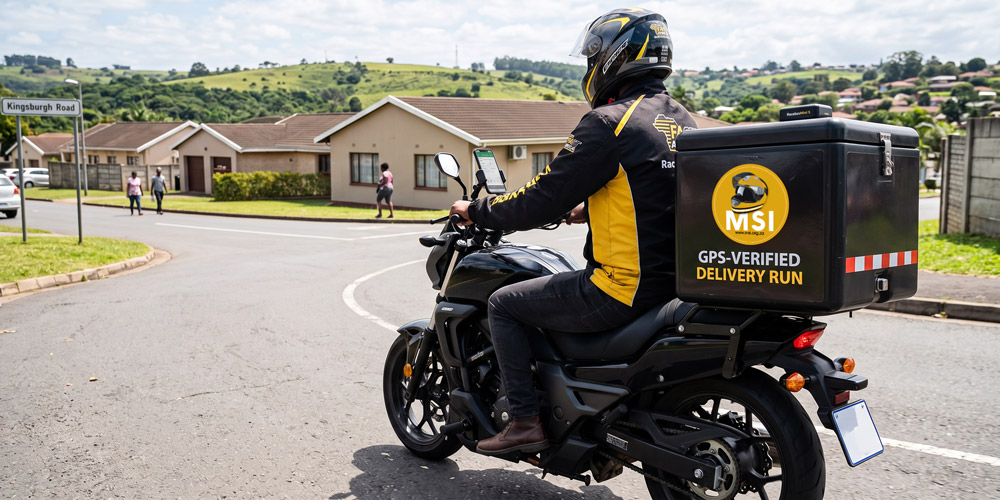
Each test is run both unladen and laden, with the rated payload in the load box, because that is how the bike will work.
- Acceleration: 0–60 km/h, the speed range that matters in urban delivery work.
- Stopping distance: a measured stop from 50 km/h using both brakes.
- Sustained speed: whether a fully loaded bike holds 80 km/h without strain.
- Cornering: performance is measured at lean angle, painting a more complete riding picture.
- Hill starts: whether the bike pulls away cleanly on a steep gradient with a full load.
- Speedometer accuracy: indicated speed compared with true GPS speed.
- Fuel consumption: measured fill-to-fill over the full test route.
Because the method is the same every time, results can be compared between models, suppliers and production batches. When a fault is fixed, the bike can be retested to prove the fix worked.
A complete evaluation, not just numbers
Performance data is one part of the MSI Delivery Motorcycle Evaluation. The full process covers the bike from the moment it is delivered to the end of the test ride.
- As-delivered inspection: fasteners, cable routing, chain, tyres, fluids, welds, load carrier and electrics, checked before the first ride.
- Safety gate: brakes, steering, lights, horn, stands and throttle return. Any failure here stops the evaluation until it is fixed.
- Measured performance: the GPS-verified tests above.
- Fit for purpose: bike and load box stability, handlebar and load box position, suspension, vibration, heat, controls, mirrors and lighting, assessed with a smaller and a larger rider.
- Post-ride re-inspection: anything that has loosened, leaked or worn during the test.
Every problem is logged by severity (Critical, Major or Minor) and assigned to whoever must fix it: the manufacturer, the PDI workshop or the accessory supplier. The evaluation ends with one clear recommendation: Buy, Buy with Conditions, or Do not Buy.
Tested where the bikes work
We test in the real operating environment: at distribution centres (controlled environment) and on public roads (real-world environment), always within the posted speed limit. Acceleration runs are done in 60 km/h zones and sustained-speed runs in 80 km/h to 100 km/h zones, on public roads at specific times. Slow-speed stability is assessed on a course in the yard, measuring load shifts and steering effect.
Altitude is recorded for every test. A motorcycle tested at the coast will perform noticeably better than the same bike on the Highveld, where Johannesburg sits at around 1,750 m. If a fleet will operate inland, the report says so, so buyers are not caught out by coastal figures.
Who it is for
- Fleet owners and operators who want objective data before committing to a purchase, and proof that problems have been fixed before bikes go on the road.
- Importers and distributors who want independent figures to support fleet proposals, and a clear list of what to correct at factory or PDI level.
The same process applies to any motorcycle, not only delivery bikes.
To book a delivery motorcycle evaluation or see a sample report, contact the Motorcycle Safety Institute of South Africa at info@msi.org.za
The Motorcycle Safety Institute of South Africa (MSI) offers various industry-specific services to the benefit of riders and industry stakeholders alike.