Here is a scenario that plays out on South African roads every single day.
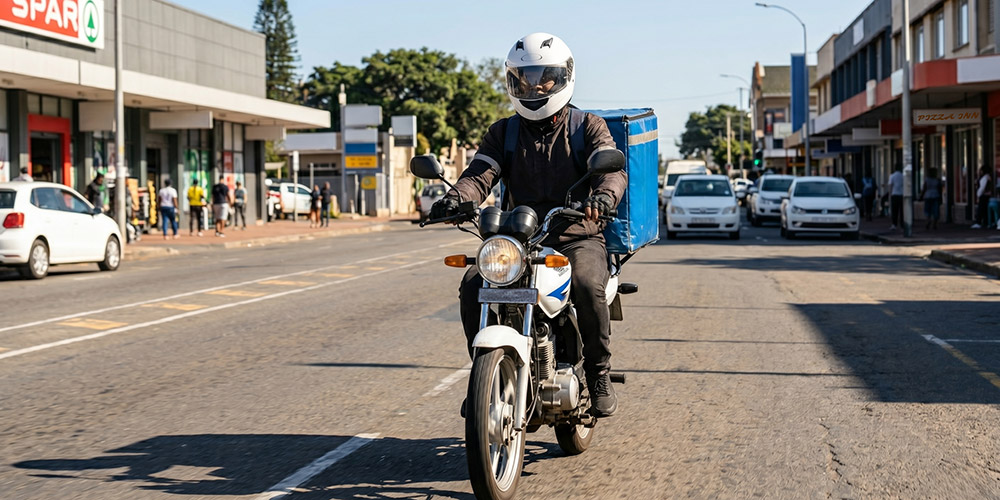
A delivery rider approaches an intersection. They activate their indicator to signal a right turn. In their mind, they have done everything correctly, and they have communicated their intention to other road users. A vehicle approaching from the opposite direction pulls out, turning across the rider’s path. The driver did not see the indicator. The rider had no time to react.
The rider did nothing wrong. The vehicle driver may genuinely not have seen the signal. So, what went wrong?
In many cases, the answer is not rider error and not driver inattention. The culprit may be the indicator lens fitted to the motorcycle.
Why Indicator Visibility Matters More Than You Think
When we talk about motorcycle visibility, the conversation usually centres on the rider being seen, high-visibility jackets, headlights on, and other conspicuity aids. All of that is important. But there is a second visibility problem that receives far less attention: the visibility of the motorcycle’s own signalling lights.
An indicator that is technically functioning, flashing at the correct rate, with a working bulb or LED, can be completely invisible to an approaching road user in bright, direct sunlight. Not dim. Not hard to see. Invisible!
This is not a theoretical concern. It is a real-world optical problem, and it is directly linked to the type of indicator lens fitted to the motorcycle.
Three Configurations, Three Very Different Results
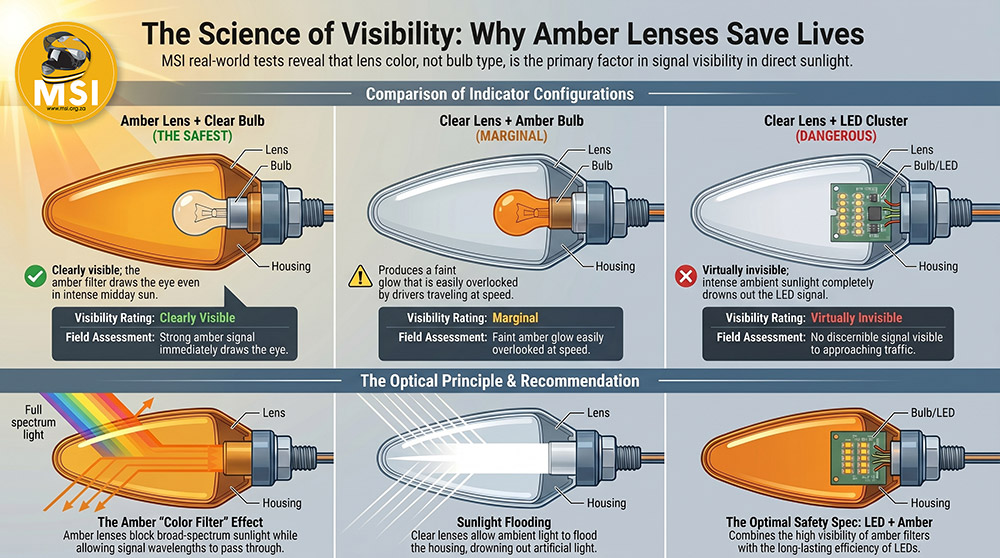
MSI conducted a comparative visual assessment of three common indicator configurations, observed from the perspective of an approaching road user under identical conditions, direct midday sunlight on a clear day. The three configurations were:
The results were unambiguous:
Configuration 1 — Amber lens with clear incandescent bulb: Clearly and immediately visible. The amber signal stood out against the surrounding bodywork and environment. An approaching road user did not need to be actively looking for the indicator — it drew the eye naturally. This is what an indicator is supposed to do.
Configuration 2 — Clear lens with amber incandescent bulb: A marginal improvement. A faint amber glow was visible in some conditions, but it was subtle enough to be easily overlooked, particularly by a driver travelling at speed or with any degree of visual distraction.
Configuration 3 — Clear lens with LED cluster: The indicator was virtually invisible. Despite the LED cluster functioning correctly, the clear lens offered no protection against the intense ambient light. From the approaching road user’s perspective, there was no visible signal — no amber colour, no flashing, nothing to draw the eye. The indicator looked identical whether it was on or off.
The Science Behind It
The reason for this difference comes down to a straightforward optical principle.
Direct sunlight is broad-spectrum and extremely intense. When it strikes a clear indicator lens, it passes straight through and floods the indicator housing with ambient light. The artificial light source, whether an LED cluster or an incandescent bulb, is then required to compete against the ambient light to be seen. In most daytime conditions, it loses that competition. The sunlight simply overwhelms it.
An amber indicator lens behaves differently. It acts as a colour filter. The amber lens blocks most of the broad-spectrum ambient sunlight from passing through, while allowing the amber wavelengths produced by the light source to remain visible. As a result, the artificial light is no longer fighting the full intensity of sunlight. It is only competing against the narrow band of light that shares its wavelength, and that is a fight it can win.
Think of it in photographic terms. A photographer using a coloured filter on a lens does not reduce the amount of light entering the camera for the sake of it, they use the filter to isolate specific wavelengths and give them prominence over others. An amber indicator lens does the same thing for the light source behind it.
The amber lens does not make the bulb or LED brighter. It makes the signal more visible by controlling what ambient light can interfere with it.
This Is a Specification Issue, Not a Technology Issue
It is important to be clear about what this problem is and what it is not.
This is not an argument against LED technology. LEDs offer real and meaningful advantages in high-utilisation applications: they last significantly longer than incandescent bulbs, they consume less power, and they respond faster. These are genuine benefits, particularly for delivery fleets, where maintenance costs and vehicle downtime directly impact operations.
The problem is not the light source. The problem is pairing a modern LED cluster with a clear lens, and assuming that the brightness of the LED will compensate for the absence of an amber filter. It does not, at least not under direct sunlight conditions.
The move toward clear indicator lenses in motorcycle design has been largely aesthetic. Clear lenses give motorcycles a cleaner, more contemporary look. The industry has adopted them widely, and in many cases without adequately considering real-world daytime visibility from the perspective of other road users.
The solution is not to abandon LED technology. The solution is to fit the LED cluster, or any light source, behind an amber lens.
An LED cluster behind an amber lens represents the optimal specification: the longevity and efficiency of LED technology, combined with the daytime visibility protection of the amber filter. This is the combination that fleet operators should be specifying, and that manufacturers and distributors should be supplying as standard.
Recognition Where It Is Due
It is worth acknowledging that several motorcycle models currently in active use in the South African delivery sector are already fitted with amber indicator lenses as standard. This is the correct specification, and the manufacturers and distributors supplying these models to the South African market deserve recognition for maintaining it.
Hero Motorcycles, TVS Motor Company, and, on some Big Boy models, are examples of manufacturers whose delivery-oriented models in the South African market include amber indicator lenses. This is the kind of specification decision that directly affects rider safety on the road, and it is the right one.
The concern arises where clear lens configurations appear on models that are being introduced into or are already operating within delivery fleets. Fleet operators, procurement managers, and distributors need to be aware of this distinction and factor it into their vehicle selection and specification criteria.
What This Means for Fleet Operators and Procurement Managers
If you are responsible for specifying or procuring motorcycles for a delivery fleet, the indicator lens type should be on your evaluation checklist. It is a small detail with significant safety implications.
Practically, this means:
- Specify amber indicator lenses as a procurement requirement, not an optional preference.
- Ask your distributor or supplier to confirm the indicator lens specification on any model under consideration before purchase.
- Do not assume that an LED indicator is automatically more visible than an incandescent one. In direct sunlight, the lens matters more than the light source.
- Consider raising the amber lens requirement with your suppliers as a minimum standard for any fleet motorcycle supplied into the South African operating environment.
What This Means for Importers, Distributors, and Manufacturers
The South African operating environment places motorcycles in direct, intense sunlight for a significant portion of their working hours. This is particularly true in coastal regions and on the Highveld. Indicator visibility standards that may be adequate in overcast Northern Hemisphere conditions are not necessarily adequate here.
MSI encourages importers, distributors, and manufacturers to:
- Review indicator lens specifications across their delivery-oriented model range with daytime visibility as a primary criterion.
- Retain amber lens specifications on models where they are already fitted.
- Where clear lens configurations currently exist, consider transitioning to amber lenses, whether retaining incandescent bulbs or upgrading to LED clusters pointing directly at the back of the amber lens.
- Support or conduct independent real-world visibility testing under direct sunlight conditions as part of ongoing product development and safety review.
What This Means for Riders
If you ride a motorcycle fitted with clear indicator lenses, you need to understand that your indicator signal may not be as visible to other road users as you assume, particularly in bright conditions.
This does not mean you should stop indicating. Indicating is always the right thing to do. But it does mean you should not rely on your indicator alone to communicate your intention. Ride with the awareness that other road users may not have seen your signal, and adjust your road positioning, speed, and approach to intersections accordingly.
If you have any influence over the specification of your motorcycle, whether you are an owner-operator or part of a fleet, advocate for amber indicator lenses. It is a simple, low-cost specification that directly improves your visibility to other road users.
The Bottom Line
A rider who activates an indicator has done the right thing. They have signalled their intention. They have met their responsibility under road traffic law. But if the indicator is not visible to approaching road users because of a lens specification that prioritises aesthetics over function, that rider remains in danger through no fault of their own.
Indicator visibility is not a minor technical detail. It is a safety-critical specification that affects every road interaction a delivery rider has at an intersection or during a lane change. In a country where motorcycle fatalities remain unacceptably high and where the delivery rider population is growing rapidly, this is precisely the kind of issue the industry needs to take seriously.
The fix is straightforward. The amber lens works. Keep it.
Contact Us
The Motorcycle Safety Institute of South Africa (MSI) is an independent motorcycle safety training and research organisation. We work with fleet operators, distributors, manufacturers, riders, and regulatory bodies to improve rider safety outcomes across South Africa.
If you would like to discuss indicator visibility, fleet safety specifications, or rider training programmes, we would be glad to hear from you.
© Motorcycle Safety Institute of South Africa. This article may be shared freely for road safety awareness purposes, with attribution to MSI.